HIV Tests
What is HIV?
HIV stands for human immunodeficiency virus, a virus that targets our immune system and destroys a group of white blood cells called CD4 cells or T-lymphocytes. When our immune system is sufficiently weakened by HIV, infections which are normally mild may cause severe disease or even death, and we become more prone to getting certain cancers. At a late stage of HIV infection, patients develop a condition called AIDS, or Acquired Immunodeficiency Syndrome. This is an advanced and very serious stage of HIV infection. If left untreated, patients with AIDS are likely to catch severe and potentially fatal infections or develop cancers like lymphomas or cervical cancer.
How do I know if I have HIV?
Many patients with HIV do not experience any symptoms. Those who have symptoms, often within a few weeks of encountering the infection, may complain of one or more of the following:
- Fever
- Body aches / headaches
- Fatigue
- Sore throat
- Swollen lymph glands, often felt at the neck, armpits and groin.
- Night sweats
- Rash
These are typical symptoms of acute seroconversion illness after HIV infection, but are also common symptoms in other viral infections. You can read more about symptoms of HIV infection here.
Hence, the only way to know for sure if a person has been infected with HIV is to go for a HIV test.
So should I be tested?
Current guidelines from our Communicable Disease Agency (CDA) recommend that every adult at the age of 21 years or above should get tested for HIV at least once in their lifetime, regardless of perceived risk factors. In addition, certain situations may warrant more frequent testing, such as if:
- you have been diagnosed with another sexually transmissible infection
- you have multiple or casual sexual partners or have received service from commercial sex workers
- you deem your partner to be at risk or are unsure of your partner’s sexual history
- there is a change in your sexual partner
- you had piercings, tattoos, dental work, surgical procedures or blood transfusions performed at places where hygiene and regulatory standards are poor or uncertain.
If you feel that you may be at risk of HIV, do come and speak with our doctors about HIV testing. Knowing one’s status early allows him or her to be on treatment early. While HIV remains incurable, early treatment gives us the best chance of suppressing the viral load, which will let you live a life not very different from someone who does not have HIV infection.
So what are the tests that I can do?
A full range of HIV tests are available at The Pegasus Clinic. Depending on risk level and time from potential exposure, the following tests may be appropriate:
|
Time from exposure |
Available Tests |
Remarks |
|
0 – 10 days |
Consider HIV PEP if exposure is high risk; Otherwise, consider testing based on timelines below. |
$120-180 |
|
10 – 14 days |
HIV PCR | Usually 7-10 working days |
|
15 – 28 days |
HIV P24 Antigen / Antibody test (also known as HIV Combo test / HIV Duo test)
|
$120-180 (incl GST)results in 2-3 working daysabout 20 min |
|
after 28 days |
HIV P24 Antigen / Antibody test (as above) HIV antibody tests
|
From $120 From $36 (incl GST) results in 2-3 working days $65 ( about 20 min ) $65 ( about 20 min ) |
|
3 months and beyond |
HIV antibody tests (as above) |
Most circumstances which may expose you to HIV may also expose you to other STIs. You may wish to consider testing for other STIs.
What is the risk of HIV?
This question may be one of the most common ones from patients coming for HIV counselling and testing. And yet this is probably one of the most difficult questions to answer. Do a search on the internet and you may find numerous websites, from official US CDC (Centers for Disease Control & Prevention) sites to Q&A websites, which give a range of figures pertaining to the risk of HIV transmission via various forms of sexual acts. Unfortunately, these figures may not always be the same. The reason for this includes :
• Patients or subjects of research often engage in multiple different sex acts in each sexual encounter.
• Patients or subjects of research may engage in multiple encounters (either reported or unreported, involving different sex acts each time) within a short period of time, in between getting their HIV tests done.
• There is inherent difficulty in doing research and getting precise statistics in a discipline which is very private and often still carries significant stigma. Much of the information on number of partners and types of sex acts depend on subjects’ self-reporting.
To simplify the issue, we have categorised the various sexual and non-sexual exposures based on their approximate risk level. Bear in mind that there can be several factors which increase or decrease the risk, even within each category. Where figures are available and likely to be reliable, we have quoted the lowest and highest estimated risk from various sources but we believe that the risk category is likely to be more relevant for patients trying to understand their chances of infection.
| Risk Category | Type of Exposure (assuming partner is HIV positive) | Remarks |
| Very high risk | Blood transfusion of infected blood | >90% |
| Needle sharing amongst IV drug users | 0.67% | |
| Receptive anal sex | 0.4% – 3.38% | |
| Moderate to high risk | Receptive vaginal sex | 0.08% to 0.19% |
| Insertive anal sex | 0.06% – 0.62% | |
| Insertive vaginal sex | 0.03% – 0.1% | |
| Low risk | Receptive oral sex | Extremely rare |
| Negligible / Theoretical risk (theoretically possible but extremely unlikely and no well-documented cases) | Insertive oral sex ‘Rimming’ / Peri-anal licking Sharing sex toys Biting Spitting Throwing body fluids eg. semen/saliva | No documented cases; carries risk of other STIs if unprotected Carries risk of other STIs Carries risk of other STIs Risk of wound infection |
| Factors which increase the risk | Presence of a concomitant STIPresence of sores or wounds or ulcers High viral load in partner With ejaculation (for receptive partner) | |
| Factors which reduce the risk | Anti-retroviral (ARV) treatment in affected partner | 96% reduction(1) |
| Consistent and correct condom use | 80% reduction(2) | |
| Male circumcision | 50-60% reduction (in female-to-male transmission) |
1 Cohen MS, Chen YQ, McCauley M, et al; HPTN 052 Study Team. Prevention of HIV-1 Infection with early antiretroviral therapy. N Engl J Med 2011;365(6):493-505.
2 Weller SC, Davis-Beaty K. Condom effectiveness in reducing heterosexual HIV transmission (Review). The Cochrane Collaboration. Wiley and Sons, 2011.
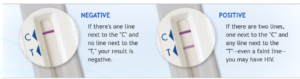
Below: Oraquick HIV rapid test – positive test
What do i do if the test turns out positive?
If the initial screening test is positive, a second blood sample will need to be sent for a confirmatory test called the Western Blot. This test typically takes about 2 weeks to be ready. No fasting or other special preparation is required.
The Western Blot may show:
• Negative (good news! But consider repeating antibody test in 3 months if there has been risk of exposure)
• Indeterminate (Consider repeating antibody test or P24 Combo test in 1 month if there has been risk of exposure)
• Positive (Our doctor will discuss the subsequent options for treatment and follow up with you)
HIV is certainly a serious infection, but options now exist for patients to have the infection suppressed and controlled. This can help reduce or delay the late complications of HIV infection and help protect your sexual contacts from HIV. Therefore it is crucial to take the first step and be tested.
Some additional information is provided below, together with links to the original site / source.
1) From the US CDC (Centers for Disease Control and Prevention) website
| Type of Exposure | Risk per 10,000 Exposures |
|---|---|
| Parenteral | |
| Blood Transfusion | 9,000b |
| Needle-sharing during injection drug use | 67c |
| Percutaneous (needle-stick) | 30d |
| Sexual | |
| Receptive anal intercourse | 50e, f |
| Receptive penile-vaginal intercourse | 10e, f, g |
| Insertive anal intercourse | 6.5e, f |
| Insertive penile-vaginal intercourse | 5e, f |
| Receptive oral intercourse | lowe, i |
| Insertive oral intercourse | lowe, i |
| Otherh | |
| Biting | negligiblej |
| Spitting | negligible |
| Throwing body fluids (including semen or saliva) | negligible |
| Sharing sex toys | negligible |
References
a Factors that increase the risk of HIV transmission include sexually transmitted infections, early and late-stage HIV infection, and a high level of HIV in the blood. Factors that reduce the risk of HIV transmission include condom use, male circumcision, and use of antiretrovirals.
b Donegan E, Stuart M, Niland JC, et al. Infection with human immunodeficiency virus type 1 (HIV-1) among recipients of antibody-positive blood donations. Ann Intern Med 1990;113(10):733-739.
c Kaplan EH, Heimer R. A model-based estimate of HIV infectivity via needle sharing. J Acquir Immune Defic Syndr 1992;5(11):1116-1118.
d Bell DM. Occupational risk of human immunodeficiency virus infection in healthcare workers: an overview. Am J Med 1997;102(5B):9-15.
e Varghese B, Maher JE, Peterman TA, Branson BM, Steketee RW. Reducing the risk of sexual HIV transmission: quantifying the per-act risk for HIV on the basis of choice of partner, sex act, and condom use. Sex Transm Dis 2002;29(1):38-43.
f European Study Group on Heterosexual Transmission of HIV. Comparison of female to male and male to female transmission of HIV in 563 stable couples. BMJ 1992;304(6830):809-813.
g Leynaert B, Downs AM, de Vincenzi I; European Study Group on Heterosexual Transmission of HIV. Heterosexual transmission of HIV: variability of infectivity throughout the course of infection. Am J Epidemiol 1998;148(1):88-96.
h HIV transmission through these exposure routes is technically possible but extremely unlikely and not well documented.
i HIV transmission through oral sex has been documented, but rare. Accurate estimates of risk are not available.
j Pretty LA, Anderson GS, Sweet DJ. Human bites and the risk of human immunodeficiency virus transmission. Am J Forensic Med Pathol 1999;20(3):232-239.
2) From the Canadian AIDS Treatment Information Exchange:
3) From this UK-based patient information website, NAM ( National AIDS Manual ):
Estimated HIV transmission risk per exposure for specific activities and events
| Activity | Risk-per-exposure |
|---|---|
| Vaginal sex, female-to-male, studies in high-income countries | 0.04% (1:2380) |
| Vaginal sex, male-to-female, studies in high-income countries | 0.08% (1:1234) |
| Vaginal sex, female-to-male, studies in low-income countries | 0.38% (1:263) |
| Vaginal sex, male-to-female, studies in low-income countries | 0.30% (1:333) |
| Vaginal sex, source partner is asymptomatic | 0.07% (1:1428) |
| Vaginal sex, source partner has late-stage disease | 0.55% (1:180) |
| Receptive anal sex amongst gay men, partner unknown status | 0.27% (1:370) |
| Receptive anal sex amongst gay men, partner HIV positive | 0.82% (1:123) |
| Receptive anal sex with condom, gay men, partner unknown status | 0.18% (1:555) |
| Insertive anal sex, gay men, partner unknown status | 0.06% (1:1666) |
| Insertive anal sex with condom, gay men, partner unknown status | 0.04% (1:2500) |
| Receptive fellatio | Estimates range from 0.00% to 0.04% (1:2500) |
| Mother-to-child, mother takes at least two weeks antiretroviral therapy | 0.8% (1:125) |
| Mother-to-child, mother takes combination therapy, viral load below 50 | 0.1% (1:1000) |
| Injecting drug use | Estimates range from 0.63% (1:158) to 2.4% (1:41) |
| Needlestick injury, no other risk factors | 0.13% (1:769) |
| Blood transfusion with contaminated blood | 92.5% (9:10) |
References
- Boily MC et al. Heterosexual risk of HIV-1 infection per sexual act: systematic review and meta-analysis of observational studies. Lancet Infect Dis 9(2): 118-129, 2009
- Vittinghoff E et al. Per-contact risk of human immunodeficiency virus transmission between male sexual partners. American Journal of Epidemiology 150: 306-311, 1999
- Del Romero J et al. Evaluating the risk of HIV transmission through unprotected orogenital sex.AIDS 16(9): 1296-1297, 2002
- Townsend C et al. Low rates of mother-to-child transmission of HIV following effective pregnancy interventions in the United Kingdom and Ireland, 2000-2006. AIDS 22: 973-981, 2008
- Baggaley RF et al. Risk of HIV-1 transmission for parenteral exposure and blood transfusion. AIDS 20: 805-812, 2006
Keywords: HIV, HIV Test, HIV Test Singapore, HIV Testing Singapore, HIV Screening, HIV Singapore, HIV Clinic, HIV Clinic Singapore, Singapore HIV Test, Singapore HIV Testing, SG